
Lessons from Newhall

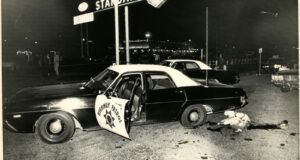
The Newhall Incident didn't just leave four families without husbands and fathers. It sent a shockwave through law enforcement training nationwide that is still felt today. Every high-risk traffic stop procedure, every speedloader on a duty belt, every felony stop protocol in use in America right now carries the fingerprints of what happened in that parking lot in Valencia, California on the night of April 5, 1970.
Here's what the investigation found — and what it means for anyone who carries a firearm.
The first and most significant factor was the decision to approach before backup arrived. Gore and Frago proceeded to approach and search the suspects immediately after pulling them over. Had they waited for Pence and Alleyn to arrive within a minute or so, it is possible the suspects would have surrendered or been overwhelmed when faced with four-on-two odds. This wasn't recklessness — it was a product of inexperience and the professional culture of the time, which did not yet emphasize tactical patience the way it does today. Mike Wood's definitive analysis of the incident, drawing on case files and primary source interviews, emphasizes that the criminals were hardened, experienced, and heavily armed, with a predisposition to kill. The officers were at a disadvantage from the first moment.
The lesson for armed citizens is not about traffic stops. It's about slowing down when something feels wrong. Tactical patience — taking an extra few seconds to assess, to position yourself better, to wait for conditions to improve — is a skill. The urgency of the moment can push you to act before you're ready. Resisting that pressure is something you have to practice deliberately.
The second factor was equipment and ammunition mismatch. The three officers who fired their handguns were using .357 Magnum rounds, but had trained and been certified only with .38 Special ammunition, which has significantly less recoil. The CHP standardized their ammunition after the incident, ensuring officers trained with exactly what they would carry on duty. This may sound like a minor administrative detail. It isn't. You perform under stress the way you've trained. If the recoil, the trigger pull, the sight picture, or the manual of arms is different on your carry gun than what you practice with, that gap will show up at the worst possible moment. Train with your carry ammunition. Qualify with your carry gun. There is no acceptable substitute.
The third factor was shotgun handling. Officer Frago approached the vehicle carrying his shotgun at port arms — stock against his hip, barrel pointed in the air — which left him unable to aim and fire quickly when the threat emerged. Officer Alleyn, during the exchange, ejected a live round from his shotgun. As a direct result of Newhall, the CHP revised how officers were trained to carry and handle the shotgun, and made familiarity with the long gun a core part of duty training. (Agagtraining) For armed citizens: if you keep a long gun for home defense, do you train with it? Do you practice the manual of arms under stress? A shotgun you've run fifty shells through is a very different tool than one you've never manipulated under any pressure at all.
The fourth factor — and the one that produced one of the most lasting equipment changes in law enforcement history — was the reload. The Newhall incident showed the difficulty of reloading revolvers under fire without a speedloader. Shortly afterward, the CHP became the first major state police department to approve and issue speedloaders. Officer Pence, under fire and mortally wounded, was reloading his revolver one round at a time when he was killed. He fought to the last second with what he had. The speedloader didn't exist as standard issue equipment for him. It does for every officer working today because of what happened to him. We should acknowledge what that cost.
The brass-in-the-pocket story — that Pence was found with spent casings in his pocket from training habits — has been repeated for decades in firearms courses. According to primary source investigation and confirmed by CHP officials, no spent casings were found in any officer's pocket. CHP Sergeant Harry Ingold found six brass cases on the ground next to the patrol car door, indicating Pence had dumped his spent brass on the ground before reloading. The myth appears to have originated from a separate CHP training memo about improving qualification procedures, which became conflated with the Newhall story over time. The actual lesson — reload under fire as fast as possible with whatever tools you have — is powerful enough without embellishment.
The fifth factor was the absence of body armor. None of the four officers were wearing bulletproof vests, which were not widely issued to police at the time. Three of the four were found to have died from wounds that a standard ballistic vest might have prevented. Body armor is now standard issue for law enforcement across the country, in large part because of what happened at Newhall.
For those of us who carry concealed, the lesson extends to the question of what we wear and how we prepare. Vests aren't practical for everyday civilian carry — but the principle of layering your preparedness applies broadly.
In the weeks after the shooting, the CHP created a training acronym from the word NEWHALL — Never approach a dangerous situation until adequately prepared and supported. Evaluate the offense. Wait for backup. Have a plan. Always maintain the advantage. Look for the unusual. Leave the scene when in doubt. That framework was built from grief. It has protected officers ever since.
Mike Wood's book, Newhall Shooting: A Tactical Analysis, is the most thoroughly researched account of the incident available and draws on primary source case files and interviews rather than the myths that have accumulated around the story over fifty years. We recommend it to anyone who carries a firearm. It is not an easy read — the photographs alone make that impossible — but it is an important one.
Officers Walt Frago, Roger Gore, James Pence, and George Alleyn didn't have the training, the equipment, or the institutional knowledge that exists today. We do — because of them. The least we can do is use it.
Be safe. Be well


Comments